





 Learning Dutch
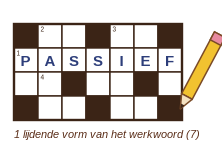
"Lijdende vorm van het werkwoord, 8 letters." If you do Dutch crosswords, you know clues like this one: a term from grammar (here the passive voice), and an answer that is often Latin. Here they are together, by subject, with the number of letters and a few words on what they mean. For when you're stuck, and for when you want to know why the answer fits.
Short answer: lijdende vorm van het werkwoord, the passive: PASSIVUM (8 letters) or PASSIEF (7). Bedrijvende vorm, the active: ACTIVUM (7) or ACTIEF (6). Meervoud, the plural: PLURALIS (8); enkelvoud, the singular: SINGULARIS (10).
1 The verb
| Clue | Answer | What it is |
|---|---|---|
| lijdende vorm (van het werkwoord) | PASSIVUM (8) | the passive voice; also PASSIEF (7): (the house is being sold); the Dutch passive |
| lijdende vorm, 7 letters | PASSIEF (7) | the Dutch form of the Latin passivum |
| bedrijvende vorm | ACTIVUM (7) | the active voice; also ACTIEF (6): (the estate agent sells the house) |
| werkwoord | VERBUM (6) | the Latin word for verb; separable verbs |
| tegenwoordige tijd | PRESENS (7) | the present tense: ik werk (I work) |
| onvoltooid verleden tijd | IMPERFECTUM (11) | the simple past: ik werkte (I worked); in crosswords also PRETERITUM (10) |
| voltooid tegenwoordige tijd | PERFECTUM (9) | the present perfect: ik heb gewerkt (I have worked) |
| voltooid verleden tijd | PLUSQUAMPERFECTUM (17) | the past perfect: ik had gewerkt (I had worked) |
| toekomende tijd | FUTURUM (7) | the future tense: ik zal werken (I will work) |
| voltooid deelwoord | PARTICIPIUM (11) | the past participle: gewerkt, gelopen (worked, walked) |
| onbepaalde wijs | INFINITIEF (10) | the infinitive, the whole verb: werken (to work) |
| gebiedende wijs | IMPERATIEF (10) | the imperative: Werk!, Kom binnen! (work, come in) |
The longest answer on this page is PLUSQUAMPERFECTUM, 17 letters, for a tense you hardly notice in an ordinary sentence: (I had already eaten).
2 Parts of speech
| Clue | Answer | What it is |
|---|---|---|
| zelfstandig naamwoord | SUBSTANTIEF (11) | a noun; also NOMEN (5): huis, liefde (house, love) |
| bijvoeglijk naamwoord | ADJECTIEF (9) | an adjective: een groot huis (a big house) |
| bijwoord | ADVERBIUM (9) | an adverb: snel, niet (quickly, not); niet or geen |
| voornaamwoord | PRONOMEN (8) | a pronoun: ik, je, u (I, you, the polite you); je or u |
| lidwoord | ARTIKEL (7) | an article: de, het, een (the, the, a) |
| voorzetsel | PREPOSITIE (10) | a preposition: in, op, naast (in, on, next to) |
| voegwoord | CONJUNCTIE (10) | a conjunction: want, omdat, tenzij (for, because, unless); want or omdat, hoewel, tenzij, mits |
| tussenwerpsel | INTERJECTIE (11) | an interjection: au!, hè, o (ouch, eh, oh) |
| telwoord | NUMERALE (8) | a numeral: drie, derde (three, third) |
Teacher tip Learn a Latin name together with one example: PASSIEF with het huis wordt verkocht, PLURALIS with huizen. A name with an example sticks; a list of names doesn't. And as a learner of Dutch, you'll meet the same names in every grammar book.
3 The sentence
| Clue | Answer | What it is |
|---|---|---|
| onderwerp | SUBJECT (7) | the subject, who or what does something: De makelaar belt (the estate agent is calling) |
| lijdend voorwerp | OBJECT (6) | the direct object: Ik koop een huis (I'm buying a house) |
| gezegde | PREDICAAT (9) | the predicate, what is said about the subject: belt terug (calls back) |
| naamval | CASUS (5) | grammatical case, almost gone from Dutch: ter plaatse (on the spot), des te beter (all the better) |
4 Sounds and letters
| Clue | Answer | What it is |
|---|---|---|
| klinker | VOCAAL (6) | a vowel: a, e, i, o, u |
| medeklinker | CONSONANT (9) | a consonant: b, k, s … |
| tweeklank | DIFTONG (7) | a diphthong: ui, ei, ou |
| lettergreep | SYLLABE (7) | a syllable: huis-werk, ap-pel, ver-hui-zen (homework, apple, to move house) |
| klemtoon | ACCENT (6) | word stress: KOFfie, caDEAU (coffee, present) |
5 Words and meaning
| Clue | Answer | What it is |
|---|---|---|
| meervoud | PLURALIS (8) | the plural: huizen (houses); Dutch plurals |
| enkelvoud | SINGULARIS (10) | the singular: huis (house) |
| verkleinwoord | DIMINUTIEF (10) | a diminutive: huisje (little house) |
| woord met dezelfde betekenis | SYNONIEM (8) | a synonym: fiets and rijwiel (both a bicycle) |
| woord met de tegengestelde betekenis | ANTONIEM (8) | an antonym: groot and klein (big and small) |
| zelfde woord, andere betekenis | HOMONIEM (8) | a homonym: bank (a sofa, to sit on) and bank (for your money) |
| vergrotende trap | COMPARATIEF (11) | the comparative: groter (bigger); groter als or groter dan |
| overtreffende trap | SUPERLATIEF (11) | the superlative: grootst (biggest) |
| vaste uitdrukking | IDIOOM (6) | an idiom: (to get straight to the point); Dutch idioms at work |
| verspreking | LAPSUS (6) | a slip of the tongue: ik ben koud (I'm a cold person) instead of (I'm cold); funny mistakes in Dutch |
| overdrijving | HYPERBOOL (9) | hyperbole, an exaggeration: (I've told you a thousand times) |
| woordenschat | LEXICON (7) | vocabulary: all the words of a language, or of one person |
Tip for your language partner Solve clues together: read one out (lijdende vorm, 8 letters) and have the other person give not only the answer, but also a sentence that shows it: Whoever has the sentence gets the point.
If you like playing with language this much, you'll feel at home in our Perfect Dutch 1 course.
Test yourself
Lijdende vorm van het werkwoord, 8 letters?
PASSIVUM. With 7 letters: PASSIEF. Lijdende vorm is the passive voice.
Bedrijvende vorm, 7 letters?
ACTIVUM. With 6 letters: ACTIEF. Bedrijvende vorm is the active voice.
Meervoud, 8 letters?
PLURALIS, the plural. Huizen (houses) is the pluralis of huis.
Tweeklank, 7 letters?
DIFTONG, a diphthong, like ui in huis.
Verspreking, 6 letters?
LAPSUS, a slip of the tongue. Ik ben koud is one: what you mean is ik heb het koud.
 You'll learn more about this in the course Perfect Dutch 1 (B2+)