





 Learning Dutch
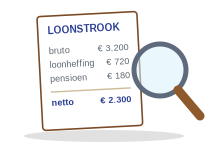
Every month you get a , also called a : your payslip. It is full of words and numbers. These are the most important ones, line by line.
Short answer: at the top is your brutoloon, your gross pay: what you earn before anything is taken off. From that, the loonheffing (tax and contributions) and sometimes a pensioenpremie (pension contribution) are deducted. What is left is your nettoloon, your net pay: the amount that reaches your bank account.
1 The lines on your payslip
| Dutch | What it means |
|---|---|
| Gross pay: your wage before anything is taken off. | |
| Hours and allowances. If you are paid by the hour: how many hours you worked, and extra pay for evening, night or weekend work, for example. | |
| Payroll tax: wage tax (loonbelasting) and national insurance contributions (premies voor de volksverzekeringen) together. Your employer pays it to the Belastingdienst, the Dutch tax office, on your behalf. | |
| Payroll tax credit: a reduction of the loonheffing. You can only get it from one employer at a time. | |
| Pension contribution: money you save for later, if your employer has a pension scheme. | |
| Net pay: what reaches your bank account. |
Teacher's tip: working for two employers? Then tell only one of them that you want the loonheffingskorting. Otherwise you will have to pay tax back later.
2 Vakantiegeld: holiday pay
Most employees get , holiday pay: at least 8% of your gross pay. Your employer often saves it up and pays it out in one go, usually in May or June. Your payslip then shows a line reservering vakantiegeld, the holiday pay being set aside. If you work through an uitzendbureau, a temp agency, it is sometimes paid out straight away, every week or every month.
3 Something not right?
Check your hours and your net pay every month. If something is not right, start by calmly asking the , the payroll department. Here, for example, the Saturday allowance is missing from the October payslip:
YouGoedemorgen. Op mijn loonstrook van oktober mis ik de toeslag voor de zaterdagen. Kunt u dat nakijken?
PayrollNatuurlijk. Ik kijk het na en laat het je deze week weten.
Almost everyone looks only at the bottom line of a payslip. Now that you have read this, you are one of the few who understand the rest as well.
Tip for your language partner Sit down together with the next payslip that comes in, and let the learner explain three lines: bruto, netto and vakantiegeld. The partner plays the curious one: En waarom is netto zoveel minder? (So why is net so much less?) Anyone who can explain it in their own words really understands it.
Reading a payslip is B1 material, the level of our Intermediate Dutch 3 course.
Test yourself
You earn €2,000 gross (bruto) a month. Do you get €2,000 in your bank account?
No. Loonheffing and often a pensioenpremie are still taken off. Your nettoloon, your net pay, is lower.
What is the minimum vakantiegeld you get?
8% of your gross pay, usually in one go in May or June.
 You'll learn more about this in the course Intermediate Dutch 3 (B1)