




 Learning Dutch
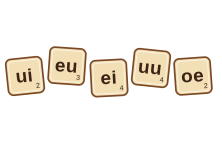
Dutch spelling looks friendly to an English reader: , , . Then a Dutch person says them: boat, bane and beer. The vowels cause most of the trouble, and some of them don't exist in English at all. Click any word to hear it. Listen first, then say it.
Short answer: ui moves: it starts from a short rounded vowel and ends in Dutch uu. eu is one steady sound: say the ay of day without letting it slide, and round your lips, like French peu or German schön. ei, also spelled ij, sits between day and die. uu is an ee with small, rounded lips, like French tu or German über. oe is the oo of food. An accent is fine: the goal is to be understood.
First, just listen: this is how they sound.
| ui | |
| eu | |
| ei/ij | |
| uu | |
| oe |
1 ui: neither ow nor oy
English speakers tend to say ow, so comes out as house. That's close to the meaning and still not the sound. Start with the short Dutch u of , roughly the vowel of British bird cut short, with rounded lips. Then slide to the uu of . Your lips stay rounded all the way: (garden), (out), (sweater).
| house | or | cover |
| belly | or | book |
| lukewarm | or | lazy |
ui and uu are easy to mix up: both have rounded lips. But in uu nothing moves. Can you hear the difference?
| house | or | rent |
| dirty | or | fire |
| mouse | or | wall |
2 eu: the vowel English doesn't have
Say ay as in day and stop before it slides towards ee. Keep your tongue exactly there and push your lips forward into a small circle. Nothing moves after that: (nose), (nice), (key). Even starts this way, with no y sound in front.
| kitchen | or | chick |
| giant | or | rose |
| door | or | through |
Yes, deur means door and door doesn't. Dutch does this on purpose, or so it feels.
3 ei and ij: not quite day, not quite die
This pair is one sound with two spellings: (ice) and (demand) sound alike. Start with the e of bed and slide up towards ee, with your lips wide: , , . So isn't wine and it isn't wane, but it lives between them.
The side to avoid is day, because that sound is close to Dutch ee:
| neighbourhood | or | week |
| she | or | sea |
If yours drifts towards die, you're in good company. Many Dutch speakers now say it that way, a pronunciation known as Polder Dutch.
Teacher tip Ij doesn't always make this sound. In (actually), (friendly) and (difficult), the ending -lijk sounds like luck with a weak, short vowel. And in (special) the ij sounds like ee.
4 uu: an ee with rounded lips
Say a long ee, as in see, or Dutch . Keep your tongue exactly there and round your lips as if to whistle. That is uu, and nothing moves: (wall), (fire), (neighbour), (minute). It's the vowel of French tu and German über. Don't slide into English you: no y in front and no w at the end.
Round your lips but let your tongue fall back, and you've said oe. That's where the meaning changes:
| neighbour | or | farmer |
| fire | or | animal feed |
| handlebar | or | tough |
5 oe: the oo of food
This is the easy one: oe is the oo of food and moon, with small, rounded lips: (book), (good), (cow), (mother). Just don't read it the English way: Dutch oe never sounds like the oe of toe. And keep it apart from oo, which is the oa of boat:
| cool | or | cabbage |
| farmer | or | drill |
| biscuit | or | I cook |
6 Letters that mislead English readers
| Spelling | Sounds like | Example |
|---|---|---|
| oo | the oa of boat | (boat) |
| oe | the oo of food | (book) |
| ee | the ay of day | (leg) |
| ie | the ee of see | (beer) |
Beer is a bear, bier is a beer. In a Dutch bar, only one of them comes in a glass.
7 An accent is fine
You don't have to sound as if you were born here. Hardly anyone who learns Dutch as an adult loses their accent completely, and nobody needs to. Dutch people may switch to English when they hear one, but that's a habit, not a verdict. The goal is to be understood without having to repeat yourself.
Listen to Vivian at the bakery. She is from England, and you can hear it. Ans understands her perfectly: listen for bruin, goedemorgen, bij and euro.
Ans, bakerGoedemorgen! Zegt u het maar.Good morning! What can I get you?
VivianGoedemorgen. Een bruin brood, graag. En twee krentenbollen.Good morning. A brown loaf, please. And two currant buns.
Ans, bakerWilt u het brood gesneden?Would you like the loaf sliced?
VivianJa, graag. En heeft u ook iets lekkers bij de koffie?Yes, please. And do you have something nice to go with coffee?
Ans, bakerDeze appelflappen zijn heerlijk. Vers uit de oven.These apple turnovers are delicious. Fresh from the oven.
VivianDan neem ik er twee. Hoeveel is het bij elkaar?Then I'll take two. How much is that altogether?
Ans, bakerZeven euro vijftig. Fijne dag nog!Seven euros fifty. Have a nice day!
So work first on what changes a word: ui and oe (buik, boek), ui and uu (huis, huur), uu and oe (buur, boer), eu and oo (reus, roos), ei and ee (wijk, week). Short and long vowels change words too (zon, zoon): see Funny Dutch mistakes.
Teacher tip Use a mirror. For ui, eu, uu and oe you should see rounded lips, for ei you shouldn't. And listen to a word a few times before you say it: if you can't hear the difference yet, you can't make it yet.
Tip for your language partner Play "Book or belly" at the kitchen table, with a book in front of you. The partner says boek or buik, and the learner points at the book or at their own belly. After five, swap: the learner says the word and the partner points. If the partner points at the wrong one, that's all the correction there is, so no explaining, just try again. One pair a day. Tomorrow it's keuken and kuiken, and you won't need the chick.
The vowels ui, eu, ei, uu and oe are A2 material, the level of our Basic Dutch 3 course.
Test yourself
Does your mouth move during eu?
No. eu is one steady sound: . During ui it does move:
Do ijs and eis sound different?
No. ij and ei are the same sound. The difference is only in the spelling.
Which word means door: deur or door?
Deur. is the door, means through.
How does the end of eigenlijk sound?
A bit like luck, with a weak vowel. You don't hear ij in -lijk.
What does "boot" mean in Dutch, and how does it sound?
A boat, and it sounds like one. Dutch oo is the oa of boat:
Buur or boer: who lives next door?
Your buur, with uu. is the neighbour, is a farmer.
Huis or huur: what do you pay every month?
The huur, with uu. is the rent you pay for your
 You'll learn more about this in the course Basic Dutch 3 (A2)