





 Learning Dutch
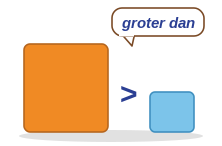
Everyone has learned it: groter dan, bigger than. And yet half the Netherlands says groter als. Is that wrong, and how bad is it? Language lovers have been debating it for a very long time.
Short answer: in standard Dutch you use dan after a comparative (groter dan, meer dan: bigger than, more than) and after anders (anders dan, different from), and als when things are equal (even groot als, zo groot als: just as big as, as big as). Groter als is common in everyday speech, but in a job application letter or a report it stands out as a mistake.
1 The rule
| Unequal: dan | Equal: als |
|---|---|
Amsterdam is bigger than The Hague. | My brother is as tall as I am. |
It costs more than I thought. | It costs as much as I thought. |
It's different from how it used to be. | It's just as it used to be. |
2 So why does everyone say it?
Because that's simply how language works. In spoken Dutch, als and dan have overlapped for centuries, and als is gaining ground. Linguists describe it as a change in progress; style guides hold on to dan in careful Dutch. For you, that means: say what you like at the kitchen table, but write dan.
Teacher's tip: not sure? Put it into English. With than (bigger than) it's dan, with as (as big as) it's als.
3 Groter dan ik or groter dan mij?
, he is taller than I, is the traditional form: you can finish the sentence with ben (dan ik ben, than I am). Groter dan mij is heard a lot too, and it's becoming more and more common in everyday speech. In formal writing, dan ik is the safest choice.
Tell someone in an argument that a person is "beter als hem", and you may win the argument, but you'll lose it with the language lovers at the table. They would have said beter dan hij.
Tip for your language partner Compare things at the table: Wat is duurder, de kaas of de wijn? (Which is more expensive, the cheese or the wine?) Wie is ouder, jij of je zus? (Who is older, you or your sister?) The learner answers with a whole sentence: Does the partner say als now and then too? Then the learner gets to correct the partner. In many homes, that's the best part of this little game.
The difference between als and dan is B2 material, the level of our Proficient Dutch 3 course.
Test yourself
"Deze cursus is intensiever ___ de vorige." (als or dan?)
dan: intensiever (more intensive) is a comparative.
"Het was even druk ___ gisteren." (als or dan?)
als: even (just as) expresses equality.
 You'll learn more about this in the course Proficient Dutch 3 (B2)